Showing posts with label conferences. Show all posts

Tuesday, August 4, 2026

Hello From Cocoa Beach: CAST 2026 is Underway: "How Avoiding Conflict Is Breaking Your Team"

 This is going to be an interesting and different CAST this go around. While I have live blogged conferences for years, I will not be doing much of that this go-around. That is because I am going to be doing live webcasting and video casting. We are launching a Webcast called "Responsive Ilities", we being me and Justin Bench. I will be posting the links to those as they go live. They will be fast clips, fun interactions, and we hope a good representation of the fun we are having here.


There will, of course, be some sessions we will not be vidcasting, such as our morning keynote right now. We are starting the conference with Dr. Jen Fry and her talk, "The Bugs Aren’t the Problem: How Avoiding Conflict Is Breaking Your Team"


The key message here is, "Software teams don’t struggle because they lack tools, frameworks, or technical skill. They struggle because the conversations that should happen… don’t."

I know this to be true, in some capacity, for every job I have ever had, both in my testing life and in the other things I do. I'm the enthusiastic, bubbly dude who likes doing, likes getting cool things done, and if there are conflicts or issues, we just let them roll off, and we figure we will just muscle through with our enthusiasm, and if we just kick enough butt, those issues will just disappear.

"Stop me, oh oh oh stop me.... stop me if you think that you've heard this one before!"

As you all know, I tend to riff on the ideas I'm hearing. I don't summarize the talk; I think through their points, and I take what I'm hearing and think through it with my own experiences.

I am intimately familiar with seeing something that I think might be wrong, but I'm unsure. Or I might want to make sure I can articulate everything before I vocalize my concerns.  Where does that come from? It comes from voicing concerns too early in the past, or thinking something is wrong but not having a full picture. What's the root problem here? I have an anxiety of looking like I don't know what I'm doing. Ever heard the phrase (paraphrased), "If you sit silently, you may be seen as a fool, but you can say what you are thinking and remove all doubt!" Yes, that's real. We all do that to a certain degree. We fear being seen as foolish or unwise, so the easiest tactic is to hold our thoughts until we are really sure. Maybe, possibly, we will gather what we need to make sure we have a thorough understanding and can present everything brilliantly. More often than not, though, life comes at you fast, and you are onto something else. Then when the problem rears its head, and others see it, you sit there thinking, "oooh, I knew that was an issue, but I didn't say anything because I didn't want to look stupid." Well, now the problem is out in the open, and I look more stupid because I held my peace until I was sure. 


Okay, so how can we counteract this very real issue people face? Part of it is practicing these words (again, this is how I handle this, or at least try to).

"I'm not fully sure I have a handle on this, but I'm noticing something that concerns me about [key area]."

"I may be missing something, but are you seeing an issue with [component]?"

"Are you familiar with this [area of misunderstanding] because I think I may have an issue... but again, I'm not sure."

Am I risking being seen as a fool right now? Absolutely. I'm sharing the fact that I'm "ignorant". Understand, that's a loaded word for many, and we hate hearing it about ourselves. Truth is, everyone is ignorant about a lot of things. Ignorance comes from Latin "ignorantia" and "ignorare", meaning "not to know" or "to be unacquainted with". I try to remind myself that "ignorance" is easily solved. I can learn, I can ask, and I can be taught. 

From a different place, I am often seen as the "psychic glue" in a group. That's a phrase a guitar player in one of my previous bands coined for me. He said that I had a tendency, due to my enthusiasm and general overall good nature (I think the phrase now would be termed 'Golden Retriever Energy' (GRE), a phrase that I actually love :) ), I make it possible for people who would struggle to interact a buffer, so that I cam the person in between who, because of my GRE, I can be that central glue point so we can all work together. Conflict doesn't stick to me or affect me when it's other people's conflict. If other people have issues with each other, I can be the go-between and easily smooth that challenge. The problem with GRE is that when the conflict comes to us, we can internalize it and think we are the problem. So we strive to make others happy and be cheerful, to hopefully cause the conflict to dissipate. I'm good at soothing issues. I'm not so good at actually resolving the conflict. The funny thing is that sometimes, my enthusiasm can have me jumping the gun at certain things, and then I get yelled at... but if people are yelling at me, they aren't yelling at each other. Since I have GRE, I can take having people be annoyed with me, and I can laugh or shrug it off easily. Net result: I glue everyone else together, and we function well,,, but you see the problem, right? Being psychic glue can be a good thing when it's applied correctly, but glue can also be messy if it's not applied correctly. Thus, I need to be willing to step back and speak more openly about the conflicts and be willing to not be seen as the happy-go-lucky golden retriever. I may not be able to be that glue at the moment, but I may be able to be the glue that is needed later on.

That's a great start. It's good to be back. Did you miss me :)?


Wednesday, October 15, 2025

Breaking the Cycle: Leading Organizations That Thrive Amid Constant Change with Allan Rennebo Jepsen (a PNSQC Live BLog)

Well, that was fast! We have reached the end of the conference with our final keynote. There has been a lot to absorb and learn over the past few days, and I've enjoyed my time here. With that, here's the closing talk for PNSQC 2025.

Allan Rennebo Jepsen is a leadership expert and author based in Copenhagen, Denmark, who has spent over two decades helping organizations adapt to change rather than fighting it. Allan opened up with an example of an online banking initiative that went horribly wrong, where everything that could go wrong did, to the point where the CEO at a corporate meeting said that a large majority of customers of the bank would not be around a year from now. Meaning their business model was cratering and they risked going out of business. Change is needed, but how in the world are they going to do it? Large banks are optimized for compliance, and because of that, they are literally designed to preserve the status quo. 


PNSQChronicles: Leading Organizations That Thrive Amid Constant Change with Allan Rennebo Jepsen

So what ends up happening? “We are trapped in a loop of meetings, updates, and alignment sessions, with initiatives and plans made, but somehow, progress keeps slipping away.” 

This ongoing “cycle of coordination” eats up energy and time while creating an illusion of progress. Wouldn't it be nice to be able to break the cycle and replace it with focused, adaptive, and empowered teams with goals and efforts that can actually move the organization forward?

As Allen points out, the one true constant is change, and change is not slowing down. New technologies, shifting customer expectations, and global competition mean that businesses must evolve faster than ever before. “Success today requires a new paradigm, one that values bold leadership over small tweaks.”

Many organizations instead fall into reactive patterns and mindsets. They organize based on what the business thinks is important, rather than looking at what the actual customers need. Every new change triggers a cascade of alignment meetings, but before that alignment solidifies, another change hits. The result is paralysis through coordination.

What will it take to break out of this vicious cycle? Genuine adaptability, that's what. Organizations that show that they can learn, adjust, and act decisively in uncertain conditions are the ones that will ultimately thrive.

What do we need to do to actually make change happen?

Strategic Prioritization

We need to focus our energy where it matters most. Not every initiative deserves attention. Leaders need to be ruthless in prioritizing efforts that drive real impact and cut through the noise of constant change.

Winning Together

Too many departments chase local wins at the expense of the organization’s overall success. Instead, focus on organizational collaboration and allow for genuine long-term thinking. Optimizing one team while degrading the system as a whole is counterproductive.

Thriving Amid Change

When teams are empowered to make decisions and take action without waiting for endless approvals, they can develop true adaptability. With those experiences, the team can get better and address challenges related to change. Success likelihood grows when teams have both the authority and the accountability to act quickly. Resilience and adaptability are learned competencies, not traits reserved for a few innovative companies. If you want to be resilient and adaptive, you need to practice and work towards being resilient and adaptive.


Allan encourages creating a “low-risk, high-impact” framework for building organizations that are genuinely adaptable. Continuous learning loops, clear ownership, and a culture of shared goals help with and reinforce the opportunities to effectively adapt to change.

As Allen points out, “These organizations didn’t get there by accident. They created the conditions where adaptability could flourish.”

Artificial intelligence, decentralized decision-making, and global competition are reshaping how organizations operate. Instead of fearing disruption, leaders should view it as a constant condition to master. Focus on adaptability as the ultimate organizational competency.

“You can’t predict the next disruption, but you can prepare your organization to handle whatever comes next.”

Key Takeaways

- Prioritize what truly matters. Avoid being spread thin across too many initiatives.

- Empower your teams. Give them the clarity and authority to act.

- Collaborate across silos. Success comes from shared goals, not isolated wins.

- Embrace continuous learning. Every challenge is a chance to adapt and improve.

If there's any one message or idea to bring home today, it is that change doesn’t have to be chaotic. Leaders who build adaptable, empowered teams will be the ones who turn constant change into a competitive advantage.

Want to know more? Allan’s book “Impactful Organizations – And How to Become One!" expands on many of the ideas shared today. 

Monsters & Magicians: Testing the Illusions of Generative AI with Ben Simo (a PNSQC Live Blog)

Day 2 of the main program is underway (Day 3 includes the workshop presentations). It's crazy to see/feel how quickly this event goes by. As always, I've had a great time at this event and enjoyed my interactions with everyone. It's especially neat to realize how many people I know in this space, and when keynote speakers are literal friends, such as today with Ben Simo. 

Machines to do things beyond our physical or mental powers have existed for thousands of years. We can go back to the Antikytheria Mechanism for what may quite possibly be the world's first "artificial intelligence," depending on how you want to interpret that term. Over time, as we have come to grips with and developed an understanding of the rules, laws, and repeatability of activities, what was magical once upon a time has become commonplace in our everyday use. 


PNSQChronicles: Brief Interview of "Monsters and Magicians" with Ben Simo on YouTube

We now see Large Language Models and predictive text generation as the current amazeballs part of our reality. Many people are excited about these technologies, but at the same time, there are many risks surfacing, with reports of organizations suffering actual harm or damage because of using AI tools. We have heard of apps that have jacked up rates arbitrarily, published legal documents with no basis in law, fact, or reality, and taken models of "virtual people" who learn from interactions and the biases and inputs trained these models to be incredibly racist and hateful. 

These situations point to an interesting set of questions: how specifically can we as testers benefit from this wild new world of seemingly random query and response systems? How do we test software that produces inexplicable fuzzy outputs? At the end of the day, software deals with patterns and algorithms. We have technologies such as machine learning, clustering, and ways that data can be grouped and sorted. If we give LLM's a closed data set of information and ask it to work with just that information, it does a remarkably good job of transforming or "creating" work and assets. The key here is that we have given it a known and bounded set of information. Because it is bounded, it is working with a known set of information and can be guided specifically as to what to do with it. As we open it to the outer world and give it fewer controls or restrictions, we open the model up to having to look at vague clusters of data with potentially dubious provenience. A great example of this that I saw in practice during one of the workshops was with the idea of creating spec documents in markdown that would reside at the base of your document tree. By making the spec document the oracle of choice, and giving the instructions that the spec document was the arbiter of what the model was to do, we limit the chance of hallucinations and odd reactions considerably. Not completely, but we make it much easier to track what the model is doing.

An example I had fun with recently was when I heard through a podcast a story of the son of Hephaistos who went to Olympus during the waning days of the Greek pantheon's influence and took a remnant of the fire from Olympus (in an homage to the myth of Prometheus). However, something about this seemed "off", as in it was being presented as an ancient myth, but it clearly wasn't. Could we identify where the original story came from? Through various prompts, reviewing the text transcript of the story, and other clues, the LLM determined that, indeed, it was a modern story being told in the manner of an ancient Greek myth, and even noted that the delivery of the story in meter and timing mimicked closely the delivery of Hesiod. I was not able to determine who wrote the story or where to find it on the internet, but the details it did provide were interesting. Many of them felt fanciful, but all of them felt plausible. That's the danger with LLM output. Unless we are diligent, the very plausibility of the output could be accepted easily as though it were fact. Closer inspection found numerous areas that were not accurate (referencing older myths that I was aware of and had history with, but attributing individuals and characters that didn't belong there). People who may not have this knowledge or familiarity might accept what's being presented as fact because it flows so naturally and just "feels right and authoritative". 

In these cases, the Boolean PASS vs FAIL rationale doesn't work. It's not that the tests pass or fail, but that large elements do pass, but there are outputs that are "off". It's not a total fail, but it's also "corrupted" in a way that we cannot simply rely on the output. Additionally, we can run tests multiple times and get slightly different outputs with the exact same information being presented. In my own world of testing AI, we use a variety of benchmarks and monitors that help us determine if the models are behaving in ways that we expect them to. We have a variety of tests and models that allow us to determine things like Performance drift, comprehensive analysis, bias drift and disparity, the currency of the data, and comparing for homoscedasticity (a $10 word that means looking at the variance of the errors in a model and determining if it is constant/consistent across all of our observations). 

A neat tool that we have is the "AI Risk Repository" which helps us identify risks and domains of use of models where the various risks can be found. By looking at the areas that are potential risks, we can better be informed or consider aspects we can apply to our testing efforts.

Ultimately, one of the key takeaways from this talk is the idea that we are at peril of being beguiled by the magic surrounding us. We want to be responsible with our use of AI, and thus, we need to test and consider how best to apply what we learn and spread that knowledge amongst our colleagues. Magic is often sleight of hand, and it's important that we understand and can understand how that sleight of hand is performed.

Tuesday, October 14, 2025

Dance Bot Showcase at PNSQC: Where Robots Move to the Beat of Quality (a PNSQC Live Blog)


 This is an interesting and unusual activity... unless you have been coming to PNSQC for at least the past 15 years. The various LEGO League entries for talks and demonstrations are nothing new. A robot dance competition? Okay, that's different ;).


This year, PNSQC is hosting the first-ever Dance Bot Showcase—a celebration of creativity, code, and community!

We are starting out with a Q&A with the various team captains and learning about the challenges they faced putting on this event, and determining the criteria necessary to make this event happen.


PNSQC 2025 Robot Dance Off


Teams featured are Gear In Motion, The Beaver Bots, and Mechanical Mages (placing 3rd, 2nd, and 1st, respectively).

The various robotics teams described a number of challenges and issues they faced while preparing for this event or for other events that they have participated in. This particular demonstration is a literal "robot dance off", meaning they need to program and choreograph robots to actually dance in sync with music. These teams demonstrate technical skill as well as showcasing creativity and artistic flair. It’s more than just a performance—it's a hands-on demonstration of how software quality, testing, and intelligent systems intersect in the real world.

Each of the youth teams engages with key software concepts like adaptability, precision, and resilience through robotics. With a mix of live performances, a student-led fireside chat on software and testing challenges related to robot programming and choreography, the Showcase connects generations through shared curiosity and learning. Oh, but that's not all. Judges will develop end-user quality criteria to determine how to evaluate and judge the participants and their robot entries. Just as we would evaluate web application software quality from the end-user perspective, we will see a variety of aspects within the dance bot competition to highlight various quality characteristics.

In addition to the three local teams, we have three international teams (from the Dominican Republic, the Democratic Republic of Congo, and Mauritius) that have also contributed presentations of their dancing robots (also included in the video footage).

Have I piqued your interest? I hope so, because as soon as I can get the footage up, we will showcase the dancing robots on our YouTube channel as well as here.

Being a Change Agent with April K Mills (Welcome to PNSQC Live Blog Stream)

Hello all, and welcome to PNSQC, coming at you from Portland State University Place Hotel and Conference Center. Some of you may be hearing concerning things coming from Portland and having been here for two days now in real time, it is absolutely quiet and normal here (though I must confess that the media I have seen of protests with people in frog and chicken suits, I love how absolutely unserious Portland is. We literally started the conference with "The Beat Goes On" marching band (I will upload and link media when I get the chance).

Everyone is a Change Agent

Our first talk/keynote today is coming from April K. Mills, and her talk is "Everyone is a Change Agent". I had a chance to discuss this wth April in our PNSQChronicles vidcast (will link here later), but the key point here is that change agents don't have to be high-power, in-charge people. Every one of us has the capability, and I'd argue the responsibility, to be the change agents our organizations need. To borrow from an idea I agree with a great deal, "everyone needs to stand for something, even if doing so means we have to stand alone".

One of the ideas that April is recommending we start right now to do and be a change agent is to stand against and fight the spread of "AI Slop." How many of us have found ourselves literally struggling with and drowning in AI-generated content in our organizations that seems to say a bunch but doesn't really mean anything? I have run into this a fair bit in social media, but it is absolutely creeping into publications and corporate marketing missives. I saw a person online coin a phrase I have now started using: "AI;DR".

Note: I use this when I am seeing obvious AI output that has been generated, reads as completely soulless, and you can see that much of it is not factual or is genuinely wrong in various areas. In these cases, I do believe that announcing "AI;DR" is an excellent response.

YouTube: PNSQChronicles episode with April K. Mills


One of the things I have always appreciated (and I'm quoting Matt Heusser is the wording here) when I come to conferences like PNSQC is that I am not looking to upend the entire world with everything I learned. First of all, it's not practical, and second, systems are developed over time, and there may well be entrenched interests to overcome. Thus, it's not practical to come back from a conference with everything under the sun to overturn everything we do. Instead, we need to find a few areas that we can implement and do so without needing permission to do those things. All of us can do that. We find a way to add a new approach, process, or method based on what we learned, and then, in a few weeks or months, when people are curious as to how we have made key improvements, we can then say/demonstrate what we have been doing. There may be varying barriers to exactly how much we can do in certain areas, but we can all do something in a different way. 

When we can implement an under-the-radar change, it's often a good idea to try it out quietly and see if the change is worth pursuing. Often, we can determine pretty quickly if our brilliant idea may not be so brilliant (or at least we discover the key contexts that help explain why we haven't tried doing this before). Make no mistake, that in and of itself is often a valuable exercise. 

Sometimes the best question we can ask is "Why?" There is an idea called the "Power Paradox" that comes from the idea that people can only do so much because they don't have the power to make changes. We hear that in politics and senior management all the time. If only we could get the people at the top to agree with us and make the changes necessary. Truth be told, we don't always need to do that, and sometimes, the best way to break down that false assumption of power is to ask why we do something (strategically, don't become the kid in the back seat asking, "Are we there yet?" every five minutes). By asking "Why?" at strategic times, we may not sway the people at the top, but we may get more of us at lower levels to also ask why, and if more of us start asking why, that often triggers those higher up to realize that this is an issue that is not serving the people it intends to. Sometimes it takes more than just asking why, but strategic action often starts from just that question.

Key Takeaway: Being a change agent doesn't have to be a major initiative, and we don't have to reinvent the wheel to be a change agent. We don't need to have the right boss, with the right budget, with the right revenue, at the right time to make changes. Often, we can make changes just by trying to do some different things, and often, we can do them without having to ask permission to do so. Start there first and work your way up :).


Monday, August 25, 2025

Building Your Tester Survival Guide with Dawn Haynes: A CAST Live Blog

For the past couple of days as we have been getting CAST ready to go, I've gone and done a number of item runs, food stops, and logistical troubleshootings with Dawn Haynes, which is a common occurrence over my years with CAST. Dawn and I have frequently been elbows deep in dealing with the realities of these conferences. One funny thing that we quipped about was the fact that any time we appear at conferences together as speakers, somehow we are always scheduled at the same time (or at least a lot of the time). I thought that was going to be the case this time as well but NO, the schedule has allowed us to not overlap... for ONCE :)!!!

I first learned about Dawn through her training initiatives long before I was actually a conference attendee or speaker. She appeared as a training course provider in "Software Test and Performance" magazine back in the mid 2000s. Point being, Dawn has been an expert in our field for quite some time, and thus ,if Dawn is presenting on a topic, it's a pretty good bet it's worth your time to sit and listen. Daw is the CEO and resident Testing Yogini at PerfTestPlus, so if you want to get a first hand experience with her, I suggest doing it if you can. For now, you get me... try to contain your excitement ;).

Onekey area tht Dawn and I are both aligned on and wholeheartedly agree with is that we are individually as testers, quality professionals, whatever we call ourselves, we are responsible for crating our own careers and if you have been in testing for an extended period, you have probably already had to reinvent yourself at least once or twice. Dawn wants to encourage all testers and quality professionals to actively develop their survival instincts. Does that sound dire. It should... and it shouldn't. Dawn's point is that testing is a flexible field and what is required one day may be old hat and not needed the next. As testers, we are often required to take on different roles and aspects. During my career, I have actually transitioned a few times into doing technical support over active day to day testing.  That's a key part of my active career curation. I've actually been hired as a tech support engineer only for them to realize that I have had a long career in software testing and the next thing I know, I'm back and actively doing software testing full time. In some cases, I have done both simultaneously and that has kept me very busy. My point is, those are examples of ways that testing skills can be applied in many different ways and with many different jobs. 

Automating stuff, doing DevOps, running performance or security audits, or looking at areas your organization may not be actively working towards and playing around with those areas. As you learn more and bring more to the table, don't be surprised that you may be asked to do more of it or leverage those skills to learn about other areas.

Some areas are just not going to be a lot of fun all of the time. Sometimes you will take a while to get the skills you need. You may or may not get the time to do and learn these things but even if you can just spend 20 minutes a day, those efforts add up. Yes, you will be slow, unsure, and wary at first. You may completely suck at the thing that you want to/need to learn. You may have deficiencies in the areas that you need to skill up on. The good news is tat's normal. Everyone goes through this. Even seasoned developers don't know every language or every aspect of the languages they work with. If you are not learning regularly, you will lose ground. I like Dawn's suggestion of a 33/33/33 aproach. Learn something for work, reach out to people, train and take care of yourself. By leveraging these three areas, we can be effective over time and have the healeth and stamina to actually leverage what we are learning. We run the risk of burning ourselves out if we put too much emphasis on one area, so take the time to balance those areas and also, allow yourself to absorb your learning. It may take significant time to get good at something but if you allow yourself the time (not to excess) to absorb what you are learning, odds are you will be better positioned to maintain and even grow those skills.

One of the best skills to develop is to be collaborative whenever possible. Being a tester is great but being able to help get the work done in whatever capacity we can is usually appreciated. A favorite phrase on my end is, "There seems to be a problem here... how can I help?" Honestly, I've never to date been turned down when I've aproached my teams with that attitude.

Glad to have the chance to hear Dawn for a change. Well done. I'm next :).   


Tuesday, October 10, 2023

Empathy is a Technical Skill With Andrea Goulet (PNSQC)


Today has been a whirlwind. I was up this morning before 5:00 a.m. to teach the penultimate class of my contract (sorry, I just love working that word into things ;) ) but suffice it to say the class is still happening while PNSQC is happening. That has made me a little tired and thus a little less blogging today. Add to that the fact I was called in to do a substitute talk in the afternoon (glad to do it but that was not on my dance card today) and I'm really wondering how we are at the last talk of the day and formal conference. regardless, we are here and I'm excited to hear our last speaker.

I appreciate Andrea talking about this topic, especially because I feel that there has been a lot of impersonal and disinterested work from many over the past several years. I was curious as to what this talk would be about. How can we look at Empathy as a technical skill? She walked us through an example with her husband where he was digging into a thorny technical problem that was interrupted by Andrea asking him for a moment. His reaction was... not pleasant. As Andrea explained, she realized that he was deeply focused on something so all-consuming that it was going to be a big deal to get his attention for needful things. Instead of it being an ugly altercation, they worked out a phrase (in this case, "Inception") to help see when a person is on a deep dive and needs to be in their focused state, at least for a little while longer. While I don't quite know that level of a dive, I have times in my own life when I get caught up in my own thoughts and I bristle when someone interrupts/intrudes. By realizing these things, we can not just recognize when we ourselves are focusing on deep dives, but we can also recognize when others are as well. This is a development of our own empathy to aid us in the process of understanding when people are dealing with things.


Okay, that's all cool, but why is this being called a technical thing? Because we are free and loose with the use of the word "technical". Technical comes from the Greek word "Techne", and techne means "skill". That means any skill is technical when we get down to it. It also means it's a skill that can be learned. Yes, we can learn to be empathetic. It's not something we are born with, it's something we develop and practice. Motivation likewise drives empathy. In many ways, empathy can be a little mercenary. That's why we get it wrong a lot of the time. We often want to reach out and help in ways that we would want to be helped, and thus our empathy is highly subjective and highly variable. Additionally, empathy grades on a curve. There are numerous ways in which we express and experience empathy. it's not a monoculture, it is expressed in numerous ways and under different circumstances and conditions. There are a variety of components, mechanisms, and processes that go into our understanding and expressions of empathy. It's how we collaborate and solve complex problems. In short, it's a core part of our desire and ability to work together.

Andrea showed us a diagram with a number of elements. We have a variety of inputs (compassion, communication) that drive the various mechanisms that end up with a set of outputs. Those outputs come down to:

  • Developing an understanding of others 
  • Creation of Trust
  • A Feeling of Mutual Support
  • An overall synergy of efforts   

 Empathy requires critical thinking. It's not all feelings. We have to have a clear understanding and rational vision of what people want, and not specifically what we want. 

On the whole, this is intriguing and not what I was expecting to hear. Regardless, I'm excited to see if I can approach this as a developed skill.


Automation, You're Doing It Wrong With Melissa Tondi (PNSQC)


This may feel a bit like deja -vu because Melissa has given a similar talk in other venues. The cool thing is I know each time she delivers the talk, it has some new avenues and ideas. So what will today have in store? Let's find out :).


What I like about Melissa's take is that she emphasizes what automation is NOT over what it is.

I like her opening phrase, "Test automation makes humans more efficient, not less essential" and I really appreciate that. Granted, I know a lot of people feel that test automation and its implementation is a less than enjoyable experience. Too often I feel we end up having to play a game of metrics over making any meaningful testing progress. I've also been part of what I call the "script factory" role where you learn how to write one test and then 95 out of 100 tests you write are going to be small variations on the theme of that test (login, navigate, find the element, confirm it exists, print out the message, tick the pass number, repeat). Could there be lots more than that and lots more creativity? Sure. Do we see that? Not often.

Is that automation's fault? No. Is it an issue with management and their desire to post favorable numbers? Oh yeah, definitely. In short, we are setting up a perverse expectation and reward system. When you gauge success in numbers, people will figure out the ways to meet that. Does it add any real value? Sadly, much of the time it does not.   

Another killer that I had the opportunity to work on and see change was the serial and monolithic suite of tests that take a lot of time to run. I saw this happen at Socialtext and one of the first big initiatives when I arrived there was to see the implementation of a docker suite that would break out our tests into groupings split into fours. Every test was randomized and shuffled to run on the four server gateways. We would bring up as many nodes as necessary to run the batches of tests. By doing this, we were able to cut our linear test runs down from 24 hours to just one. That was a huge win but it also helped us determine where we had tests that were not truly self-contained. It was interesting to see how tests were set up and how many tests were made larger specifically to allow us to do examinations but also to allow us to divvy up more tests than we would have been able to otherwise. 

Melissa brought up the great specter of "automate everything". While granted, this is impossible, it is still seen forlornly as "The Impossible Dream". More times than not, it's the process of taking all of the manual tests and putting them to code. Many of those tests will make sense, sure, but many of them will not. The amount of energy and effort necessary to cover all of the variations of certain tests will just become mind-numbing and, often, not tell us anything interesting. Additionally, many of our tests that are created in this legacy manner are there to test legacy code. Often, that code doesn't have hooks that will help us with testing, so we have to do end runs to make things work. Often, the code is just resistant to testing or requiring esoteric identification methods (the more esoteric, the more likely it will fail on you someday). Additionally, I've seen a lot of organizations that are looking for automated tests when they haven't done unit or integration tests at lower levels. This is something I've realized having recently taught a student group to learn C#. We went through the language basics and then later started talking about unit testing and frameworks. After I had gone through this, I determined if I were to do this again, I would do my best to teach unit testing, even if at fundamental levels, as soon as participants were creating classes that processed actions or returned a value beyond a print statement. Think about where we could be if every software developer was taught about and encouraged to use unit tests at the training wheels level!

Another suggestion that I find interesting and helpful is that a test that always passes is probably useless. Not because the test is necessarily working correctly and the code is genuinely good but because we got lucky and/or we don't have anything challenging enough in our test to actually run the risk of failing. If it's the latter, then yes, the test is relatively worthless. How to remedy that? I encourage creating two tests wherever possible, one positive and one negative. Both should pass if coded accurately but both approach the problem from opposite levels. If you want to be more aggressive, make some more negative tests to really push and see if we are doing the right things. This is especially valuable if you have put time into error-handling code. The more error-handling code we have, the more negative tests we need to create to make sure our ducks are in a row.

A final item Melissa mentions is the fact that we often rely on the experts too much. We should be looking at the option that the expert may not be there (And at some point if they genuinely leave, they WON'T be there to take care of it. Code gets stale rapidly if knowledgeable people are lost. Take the time to include as many people as possible in the chain (within reason) so that everyone who wants to and can is able to check out builds, run them, test them, and deploy them.

Monday, October 9, 2023

Common Pitfalls/Cognitive Biases In Modern QA with Leandro Melendez (PNSQC)


Ah yes, another date with the legendary Señor Performo :). 

Leandro is always fun to hear present and I particularly liked the premise of his talk as I frequently find myself dealing with cognitive biases, both in the way of locating them when others use them but also to admonish myself when I do (and yes, I do fall prey to them from time to time). 


I've been in the process of teaching a class for the past few months related to software test automation, specifically learning about how to use a tool like Playwright with an automated testing framework. To that end, we have a capstone project that runs for three weeks. As anyone involved in software development knows, three weeks is both a lot of time and no time at all. This is by design, as there is no way to do everything that's needed, and because of that, there are things that we need to focus on that will force us to make decisions that will not be optimal. This fits into the conversation that Leandro is having today. How do you improve and get better when you have so many pressures and so little time to do it all? 

Note: I am not trying to throw shade at my students. I think they are doing a great job, especially in the limited time frame that they have (again, by design) and seeing what choices they make (as I'm literally a "disinterested shareholder" in this project, meaning I care about the end product but I'm trying my level best to not get involved or direct them as to what to do. In part, it's not the instructor's role to do that but also, I'm curious to see the what and the why concerning the choices that are made).

We often act irrationally under pressure and with time limitations. Often we are willing to settle for what works versus what is most important or helpful. I'm certainly guilty of that from time to time. An interesting aspect of this, and one I have seen, is the "man with a hammer" syndrome, where once we have something we feel works well, we start duplicating and working with it because we know we can have great wins with that. That's all well and good but at times, we can go overboard. Imagine that you have an application with navigation components. You may find that many of those components use similar elements, and with that, you can create a solution that will cover most of your navigation challenges. The good thing? We have comprehensive navigation coverage. The disadvantage? all of that work on Navigation, while important and necessary, has limited the work on other functionalities with the unit under test. Thus, it may be a better use of time to do some of the navigation aspects and get some coverage on other aspects of the application rather than have a comprehensive testing solution that covers every navigation parameter and little else to show for it. 

Another example that Leandro gives is "Living Among Wolves" or we can consider this an example of "conformance bias" meaning that when we do certain things or we are part of a particular environment, we take on the thinking of those people to fit in with the group. Sometimes this is explicit, sometimes it is implicit, and sometimes we are as surprised as anyone else that we are doing something we are not even aware of. 

The "sunk cost" appears in a lot of places. Often we will be so enamored with the fact that we have something working that we will keep running and working with that example as long as we can. We've already invested in it. We've put time into it, so it must be important. Is it? Or are we giving it an outsized importance merely because we've invested a lot of time into it? 

One of the lessons I learned some time back is that any test that never fails is probably not very well designed or it offers little value in the long run. It's often a good idea to approach tests both from a positive and a negative perspective. It's one thing to get lucky and get something that works in a positive/happy path test (or not necessarily lucky but limited in what's being done. Now, does your logic hold up when you inver the testing idea? Meaning can you create a negative test or multiple negative tests that will "fail" based on changing or adding bogus data or multiple bogus data examples. Better yet, are you doing effective error handling with your bogus data? The point is, that so many of our tests are balanced to only happy path, limited depth tests. If you have a lot of positive tests and you don't have many tests that handle negative aspects (so that the incorrect outcome is expected... and therefore makes a test "pass" instead of fail), can you really say you have tested the environment effectively?   

Ending with a Shameless plug for Leandro. Leandro is now an author, having written "The Hitchhikers Guide To Load Testing Projects", a fun walkthrough that will guide you through the phases or levels of an IT load testing project. https://amzn.to/37wqpyx

Amplifying Agile Quality Practices with Selena Delesie (PNSQC)

I had the opportunity and privilege to introduce Selena Delesie on the program today. It was fun to reminisce a bit because Selena and I were both in the same Foundations class for Black Box Software Testing all the way back in 2010. We also both served on the Board of Directors for AST, so we had a lot of memories and fun/challenging things to deal with over the years. Thus, it was a pleasure to introduce Selena as our first Keynote speaker. Also, part of her talk was discussed on a recent The Testing Show podcast, so if you want a sample, you can listen to that :).

Selena Delesie

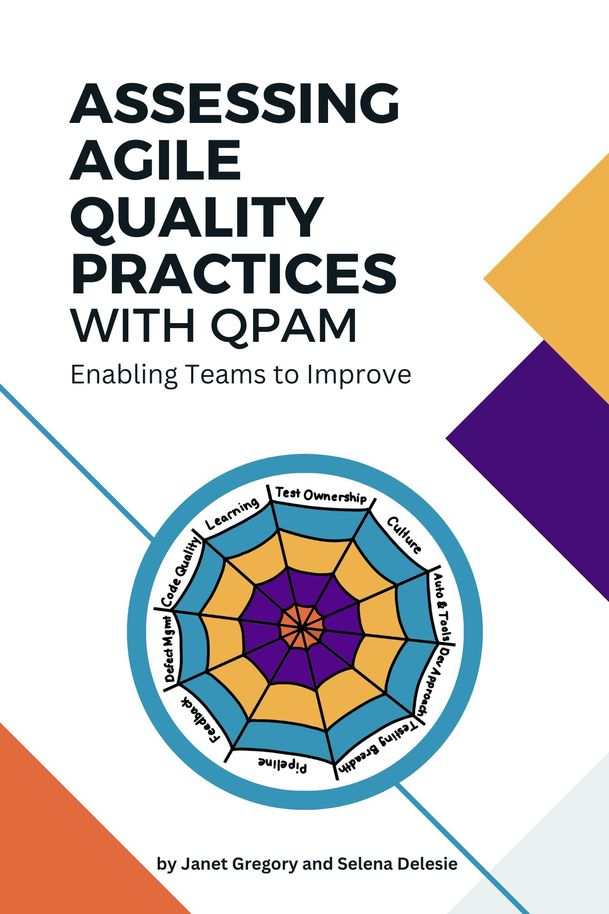
The tool that Selena and Janet Gregory put together is called the Quality Practices Assessment Model (QPAM). The idea behind this is that there are ways to identify potential breakdowns in the quality of our work. Areas we should consider are:

  • Feedback Loops
  • Culture
  • Learning and Improvement
  • Development Approach
  • Quality and Test Ownership
  • Testing Breadth
  • Code Quality and Technical Debt
  • Test Automation and Tools
  • Deployment Pipeline
  • Defect Management

The fascinating thing is the order and how these are identified and examined. Selena makes the case that the order in which these are presented and examined is important and by examining them in this order or weighting, the best chances for overall and lasting improvement are possible. Yes, Defect management is important but it will be less effective if more weight is not given to the previously mentioned items.

A key aspect to this is that quality is not just a technical issue, it's also a social issue and it should not be dealt with in isolation. Selena introduces us to a group code-named "Team Venus" and identifies many of the issues they are facing and where those issues fall on the ten quality aspects. The key element is that each area is looked at holistically and in conjunction with the other areas, not in isolation. As anyone familiar with GeneralSystems Thinking can tell you, there is no such thing as a standalone and isolated change, any modifications made will have ripple effect. It's also critical to realize that a process alone is meaningless if the overall values are not solid or agreed upon. 

In the ten quality aspects that Selena referenced, there are four quadrants/dimensions to consider:

  • Beginning
  • Unifying
  • Practicing
  • Innovating

What I like about considering these as quadrants is the fact that these areas are not separate from each other but they are dependent on each other. Some areas of the ten practices will be closer aligned with a particular dimension. Additionally, it's common for teams to spend more time in a given quadrant/dimension for the ten areas than others. I like the diagram Selena uses that looks like a spider web. The center of the web means that that is an informational or foundational level, and the farther out from the center, the greater the expertise and experience. Ideally, of course, all of the aspects should be on the outer rim of the spider web but in practice, there will be color splotches in all four of the dimensions. That is normal and should not be discouraged, especially since each new team member will typically need to start from zero.

For those interested, the book and full model example for Team Venus is available in "Assessing Agile Quality Practices with QPAM" so if you want to learn more, go there.

Amping It Up!: Back at the Pacific Northwest Software Quality Conference


It's that time of year once again. I'm excited to be at PNSQC and in a new location. We are at the University Place Hotel and Conference Center, which is part of Portland State University. This is the first time PNSQC has been here but not the first time I've been here. A few years back, in 2018, they had run out of rooms at the primary hotel, so I had to find someplace else to stay. 

I happened upon University Place, and while it was a walk from the previous venue at the Portland World Trade Center, it was a comfortable hotel, and I liked my stay. As we were looking for different places to hold the conference this year I mentioned my experience and thought it would make for an excellent possible venue. And thus, here we are. It wasn't solely up to me but I definitely put in a good word ;).

This year's conference is a strange feeling for me, as it is one in which I am feeling unsure and unsteady after many years. I am at the tail end of a contract I've been working for several months. In a few weeks, barring any changes or new contracts, I will be out of work again. Thus I am attending this conference from a different headspace than usual. Previously, I was looking for small tips I could bring back to do my current job. This year, part of me feels the need for a literal reinvention. I'm having that uneasy feeling that I have too many potential options and not enough time to consider them all, so this year's talks are probably going to be focused on my current mental state. If you see me attending talks that may seem different or out of character, that's why.

Additionally, this year had an additional challenge and excitement in that I was the Marketing Chair for PNSQC this year. If you felt that there was either too much or not enough of a marketing presence for the conference, I get both the praise and/or the blame. Either way, for those who are here and for those following along, I'm happy you are here.


Friday, April 21, 2023

Low-level Approaches for Testing AI/ML: an #InflectraCON2013 Live Blog


 One of the great parts of conferences like this is that I meet people I have interacted with for years. Jeroen is one of those people. We worked together on the book "How to Reduce the Cost of Software Testing" back in 2010 but we have never met in person before this week. We've had some great conversations here and now I finally see him present.

Jeroen Rosink Avatar

Jeroen Rosink

Sr. Test consultant, Squerist

I think it's safe to say everyone has been hit with some form of AI and ML in some capacity. If you need an explanation of AI and Machine learning, I'll let Chat GPT tell you ;).


AI, or Artificial Intelligence, refers to the development of computer systems that can perform tasks that would typically require human intelligence. These tasks might include things like recognizing speech or images, understanding natural language, making decisions, and solving problems. AI can be classified into various categories such as supervised learning, unsupervised learning, reinforcement learning, and deep learning.

Machine learning is a subset of AI that focuses on teaching computers how to learn from data without being explicitly programmed. In other words, it's a method of training algorithms to make predictions or decisions based on patterns in data. Machine learning algorithms can be trained on a variety of data types, including structured data (like spreadsheets) and unstructured data (like text or images). The most commonly used machine learning algorithms are supervised and unsupervised learning algorithms.

I mean, that's not bad, I'll take it. So I used AI to explain AI. What Inception level is this ;).

AI is always learning and it has been trained on large data sets. I often look at AI as a good research assistant. It can do some pretty good first-level drafting but it may miss out on some of the nuances and it may also not be completely up to date with the information it provides. Also, Machine Learning really comes down to ranking agents and probability. The more successes it establishes, the higher it ranks certain responses. To be clear, even with how rad AI and ML seem to be, we are still in the early days of it. We can have all sorts of debates as to how much AI will take over our work lives and make us obsolete. Personally, I don't think we are anywhere near that level but I'd be a fool to not pay attention to its advances. Therefore, we need to consider not just how we are going to deal with these things but how we are going to test them going forward.

 Jeroen talks about the confusion matrix and how that is used to test ML.

The confusion matrix is used to evaluate machine learning models, particularly in classification tasks. Think of it as a table with a number of correct and incorrect predictions made by a model for each class in a set of data.

The four possible outcomes are:
- true positives (TP)
- false positives (FP)
- true negatives (TN)
- false negatives (FN).


A true positive occurs when the model correctly predicts a positive instance.
A false positive occurs when the model incorrectly predicts a positive instance.
A true negative occurs when the model correctly predicts a negative instance.
A false negative occurs when the model incorrectly predicts a negative instance.

Jeroen has two approaches that he is recommending:

The Auditor's Approach

First, we perform a walkthrough so that we can see if the data is reliable and useful. From there, we do a Management Test to use data in enough volume to see if the data as presented works with small and larger numbers. If we can see that the data is relevant with one, and with 25, then we can see if it's relevant with 50 or 100, or 1000 and so on. We can't predict the output but we can have some suppositions as to what they might do.

The Blackhole Approach

This is an interesting approach in which we don't necessarily know what the data is or what we would actually have as data. We can't describe what is actually inside the black hole but we can describe what surrounds or is visible around the black hole. In this capacity, we look for patterns and anomalies that don't correspond with our expectations. If we see a pattern that doesn't match what we expect, we may have an issue or something that we should investigate but we are not 100% sure of that fact. Jeroen explained that there's a technique that can be used in the classic illustrations for "Where's Waldo?" The idea is that with a pen and making some marks on the page, we can figure out where Waldo is in about ten passes. To be clear, the system doesn't know where Waldo is, but it examines patterns in the image and breaks down the patterns to figure out where the item it is looking for might be.


These are neat ideas and frankly, I would not have considered these prior to today but be sure I'm going to think a lot more about these going forward :).


Technical Debt Is Not Free: an #InflectraCON2013 Live Blog


Chad Green Avatar

Chad Green

Director of Architecture, Glennis Solutions


When you hear the term "Technical Debt", what does that mean to you? Often the term "a quick and dirty fix" is used with the idea that it will be taken care of later. In short, anything you have to revisit later because of the limitations of today is specifically technical debt. 

The fact is, many of us have probably participated in the process of developing technical debt, whether we intended it or not. Even mature teams find themselves in technical debt, sometimes by active means, and sometimes by inaction. I remember working with an organization that had a great automation framework and it was very robust, with a lot of code libraries to support it. It was a great system, as long as the developers that created it were there to maintain and support it. However, we came to a point where our developers that did support this were no longer there and the team members that were there did not have the level of expertise necessary to maintain it. What was once a vital linchpin of our efforts became outdated and in some ways dangerous to do any work on. We went from having a reliable system to a need to modernize. In short, we woke up with a technical debt through no intentional effort on our part but we had to address it. We ultimately did but it took time and effort and a lot of iteration. We learned from that experience that we needed to make sure that what we developed had a broad base of support so that any of us could work on and maintain it.

Going into debt is not a crime or even a bad situation by itself. It can certainly become a bad situation if it's not addressed or worse, ignored. In many ways, we have to be more careful and make sure we are doing things in ways that are maintainable and understood. I went through this recently with some changes I proposed to a system that had a different way of handling API data (this came from suggestions of one of our devs). When I submitted it, the comments back were, "This is interesting and a way that we hadn't considered. We're not saying "no" but we may want to make sure we understand why we'd want to do it this way. Can we revisit this in the next sprint?" That's a perfectly reasonable request. Let's understand what making this change might be and how it might modify our testing methodology.

Technical debt sounds scary but there are ways to limit it or mitigate it. Take the time to do actual code reviews and make sure that the changes being made are understood. Talk about these things in Stand Up if necessary but surface these issues, as well as discuss these in your sprint reviews. Much of the time technical debt will be hiding in plain sight. The best way to deal with technical debt is to look for it and identify it as early as possible.


Bad Tests Running Wild - an #InflectraCON2023 Live Blog


Paul Grizzaffi Avatar

Paul Grizzaffi

Senior QE Automation Architect, Vaco

Paul and I go way back. It's always fun to see my fellow in heavy metal arms at these events. We frequently talk music as much as we talk testing, so we are often in each other's sessions and today is no exception. Plus, Paul and I love making musical puns in our talk titles, and seeing Bad Tests Running Wild, I knew that was a reference to Scorpions' lead-off track from 1984's "Love at First Sting", aka "Bad Boys Running Wild"... yeah, this is going to be fun :).


The point here is that, especially with CI/CD pipelines, we need to have the tests pass to successfully complete and deploy an application. If a test fails, the whole process fails. By virtue of how tests run in a CI/CD pipeline, we need to make sure that any test that we have can run all the time, independent of any other test, and independent of any state of our product. This means a flakey test can really derail us. Note, this is not talking about a test legitimately failing or finding a fault. This is more the "random timeout because of a latency that occurs and that has nothing to do with our application".    

Let's think about how we create our calls and procedures. Do we have everything under our own umbrella? How much of our solution uses third-party code? Do we understand that third-party code? If we are using threaded processes for concurrency, are all of our components able to use those concurrent thread approaches?  

Let's think about configuration and how we set things up. Why do we want or need parallelization? Overall, it comes down to time and speed. I remember well our earlier setup with Jenkins from about a decade ago. It took us several hours to run everything in serial. Thus, we needed to set up the environment in such a  way that we could run four servers in parallel. At a point, we have to look at the costs of running our CI/CD pipeline vs. the time it takes to deploy. Our sweet spot was determined to be four servers running in parallel. Those four servers ran our tests in twenty minutes and then did our deployment if everything went smoothly. Going from several hours to twenty minutes was a big time saving but yes, it cost to set up robust enough servers to get those savings in time. After those four servers, we determined that adding more servers created a less favorable cost to time savings, as compared to running four servers. Still, it was critical to make sure that any tests we ran and any states that changed had to be all self-contained. No test was allowed to leave any residual footprints. Additionally, we had to ensure that our main server and out client machines were responding quickly enough to make sure that we didn't have potential latency with multiple machines (heck, spinning up a machine in a different server farm could mess everything up, so you needed to make sure that everything was proximate to each other.   

Also, we are only considering what happens when a test fails when we don't want it to or it's not supposed to fail. However, we also have to consider the flip side, which is what happens if a test passes that shouldn't? That's the flip side of a flaky test. What if we have made a change but our test is too generic to capture the specific error that we have introduced? That means we may well have introduced a bug that we didn't or wouldn't catch. 

Risks are always going to be present and our goal as testers and automation specialists is that we want to look at the potential risks that are present. What is the basic risk we need to mitigate? What happens when we deploy our systems? Do we have the ability to back out of a change? What do we need to do to redeploy if necessary? If we deploy do we have an easy way to monitor what has gone in? Paul makes the point that, if a change is potentially expensive, then you probably need human eyes to watch and monitor the situation. If there's little cost or risk of failures, then it could be handled without a person looking over it. Regardless, you will need to have the ability to monitor and to that end, you need logs that tell you meaningful information. More to the point, you need to know where the logs are and that they are actually accessible.

As always, exciting, interesting, and great fod for thought. Thanks, Paul. Rock on!!!

The Dark Side of Test Automation: an #InflectraCON2023 Live Blog


Jan Jaap Cannegieter Avatar

Jan Jaap Cannegieter

Principal Consultant, Squerist


Jan starts out this talk with the idea from Nicolas Carr's book "The Glass Cage" that "the introduction of automation decreases the craftsmanship of the process that is automated". I've seen this myself a number of times. There's a typical strategy that I know all too well:

- explore an application or workflow
- figure out the repeatable paths and patterns
- run them multiple times, each time capturing a little more into scripts so I don't have to keep typing
- ultimately capture what I need to and make sure it passes.

The challenge with this is that, by the time I'm done with all this, unless a test breaks, that test will now effectively run forever (or every time we do a build) and honestly, I don't think about it any longer. The question I should be asking is, "If a test always passes, is it really telling us anything?" Of course, it tells me something if the test breaks. What it tells me varies. It may indicate that there's a problem but it also may indicate a frailty in my test that I hadn't considered. Fix it, tweak it, make it pass again, and then... what?  

I'm emphasizing this because Jan is. Just because a test is automated doesn't necessarily tell us how good the testing is, just that we can do it over and over again. Likewise, just because a test is automated, it doesn't really give us much indication as to the quality of the testing itself. Let me give an example from my own recent testing which revolves around APIs. On one hand, I am able to find a variety of ways to handle GET and POST commands but on the other, do I really know that what I am doing actually makes sense? I know I have a test or a series of tests but do I actually have tests that are worth running repeatedly? 

I appreciate the fact that automation does something important but it may not be the importance we really want. Automation makes test efforts visible. It's hard to quantify exploratory sessions in a way that is easy to understand. By comparison, it's easy to quantify the statement, "I automated twenty tests this week". Still, much of the time, the energy I put into test automation saves me repetitive typing, so that part is great but it doesn't specifically find bugs for me or uncover other paths that I hadn't considered. 

There are five common misunderstandings when it comes down to test automation:

- the wish to automate everything

I have been in this situation a number of times and it typically becomes frustrating. More times than not, I find that I'm spending more time futzing with tooling than I am actually learning about or understanding the product. There's certainly a variety of benefits that come with automation but thinking the machines will make the testing more effective and frequent often misses the mark.

- you can save money with test automation

Anyone who has ever spent money on cloud infrastructure or on CI/CD pipelines realizes that often having more automated testing doesn't save money at all, it actually increases cycles and spending. Don't get me wrong, that may very well be valuable and helpful in the long run but thinking that automation is going to ultimately save money is short-sighted and in the short term, it absolutely will not save money. At best, it will preserve your investment... which in many cases is the same thing as saving money, just not in raw dollar terms.

- automation makes testing more accessible

Again, automation makes testing more "Visible" and "Quantifiable" but I'd argue that it's not really putting testing into more people's hands or making them more capable. It does allow the user who maintains pipelines to be able to wrap their heads around the coverage that exists but is it really adding to better testing? Subjective at best but definitely a backstop to help with regressions.

- every tester should learn how to program

I'd argue that every tester who ever takes a series of commands, saves them in a script, and then types one command instead of ten is programming. It's almost impossible not to. Granted, your programming may be in the guise of the shell but it is still programming. Add variables and parameters and you are de facto programming. From there, stepping into an IDE has a bit more learning but it's not a radical step. In other words, it's not a matter of, "Does every tester need to learn how to program?" We invariably will. To what level and at what depth is the broader question.
 
- automation = tooling

I'm going to argue that this is both a "yes" and "no". As I said previously, you can do a lot of test automation using nothing but a bash shell (and I have lots of scripts that prove this point). Still, how do scripts work? They work by calling commands that pipe the output to some other command and then based on what we pipe to what, we do one thing or we do something else. Is this classic test tooling as we are used to thinking about it? No. Is it test tooling? Well, yes. Still, I think if you were to present this to a traditional developer, they would maybe raise an eyebrow if you explain this as test tooling. 

My rationale and it seems Jan feels a similar way is that we need to look at automated testing as more than just a technical problem. There are organizational concerns, there are perception issues, and there are communication issues. Having automation in place is not sufficient. We need to have a clear understanding of what automation is providing. We need clarity on what we are actually testing. We need to have an understanding of how robust our testing actually is and also how much of our testing is tangibly capturable in an automated test. What does our testing actually cover? How much does it cover? What does running one test tell us versus what ten tests tell us? Are we really learning more with the ten tests we run or is it just a number to show we have lots of tests?

The real answer to this comes down to, "Why are we testing in the first place?" We hope to get the information we can make judgment calls on and ultimately, automated tests have a limited ability to make judgment calls (if they can make them at all). People need to analyze and consider to see what is going on and if it is actually worthwhile. It has its place, to be sure, and I wouldn't want my CI/CD environments running without them but let's not confuse having a lot of tests with having good tests.


Castle Defense 101 (aka Threat Modeling): an #InflectraCON2023 Live Blog

Well, good morning to everyone. We woke up to some excitement today. A fore alarm went off at 7:30 a.m. this morning, so I had to evacuate the venue. It was interesting watching me react to what was happening. I've always been fond of saying I'd be one to just get up and get out but as it turns out, no, I had the presence of mind to gather my stuff quickly and push it into some bags, grab my laptop and backpack, and then walked out. Fortunately, I travel relatively lean as a principle so it didn't take me long but were it a more dire situation, I fear I may have been one of those stragglers that might have been potentially cut off. All's well that ends well but yeah, gave me pause to think, to say the least.

Anyway, on to today's sessions.

Gene Gotimer Avatar

Gene Gotimer

DevSecOps Engineer, Praeses

This talk on Castle Defense is both entertaining and an interesting look at what we might face as potential security issues and how we want to protect against potential attacks. When we think of castles, we often think of grand, large structures. Interestingly, castles all start as smaller strutcures. If we think of the old chessboards and the character of the Rook (or the Castle, yes), they are minimalist towers in many cases and typically, that's where keep and bailey castles start, too. They may be small or not terribly imposing but they can still be remarkably effective at defense if set up correctly. This is an interesting metaphor when it comes to security because, in many ways, security is graded on a curve. It also helps to know what your castle or fortress is meant to defend. A manor home for a noble is designed to keep people out. Prisons are meant to keep people in. It's important to know what you are protecting and what direction matters. 

In addition to the conversations about potential security threats for applications, we are taking the time to look at and analyze actual castles from the medieval period and later to see what they did and how they set up their defenses, and then analyze ways we could undermine its security. Granted, some of these castles have been modernized and no longer set up in a logical way that would have addressed the threats of the past (an example of a castle in the Netherlands shows a ground-level manor with what looks to be no defensive walls, windows down to the ground, and a river flowing by outside. In short, it doesn't look to be defensive in any meaningful way, until you see the center tower. That tower resembles what may have been the original structure, with a broad overhand with machicolations (I love that word so much (LOL!) ) but you can see that time and necessities have changed how the building is used. It's original threat modeling from when it was built wasn't necessary for later centuries, so the building was adapted to face more modern realities. Many castle fortifications made sense in the era of catapult and trebuchet but became obsolete with the advent of gunpowder and cannons.

 So let's consider this in the modern world. We aren't building castles and keeps in the literal sense (generally speaking for this audience) but our applications are in many ways our castles. If they are breached or hacked, our data, our financial well-being, and our reputations are on the line, so the threats, while different, are every bit as potentially devastating. Thus we need to put time and attention towards making a rational and logical level of security for our applications. Some situations are going to require more hardening than others. If you have an informational site with no database backend for transactions, your threat modeling is going to be smaller and less intensive compared to a site that handles the personal data of individuals or the literal handling of payments. A WordPress blog is going to be lower in priority compared to a banking app. We need to measure our time and investments for the threats that make sense.

There's a site called "Threat Modeling Manifesto" that spells out a broad range of these possible attacks and threats and how to handle them. From their headline:

Threat modeling is analyzing representations of a system to highlight concerns about security and privacy characteristics.

At the highest levels, when we threat model, we ask four key questions:

  • What are we working on?
  • What can go wrong?
  • What are we going to do about it?
  • Did we do a good enough job?
This was an interesting way to talk about this topic and I applaud the creative approach. It took a potntially dry topic and made it a lot more engaging.